

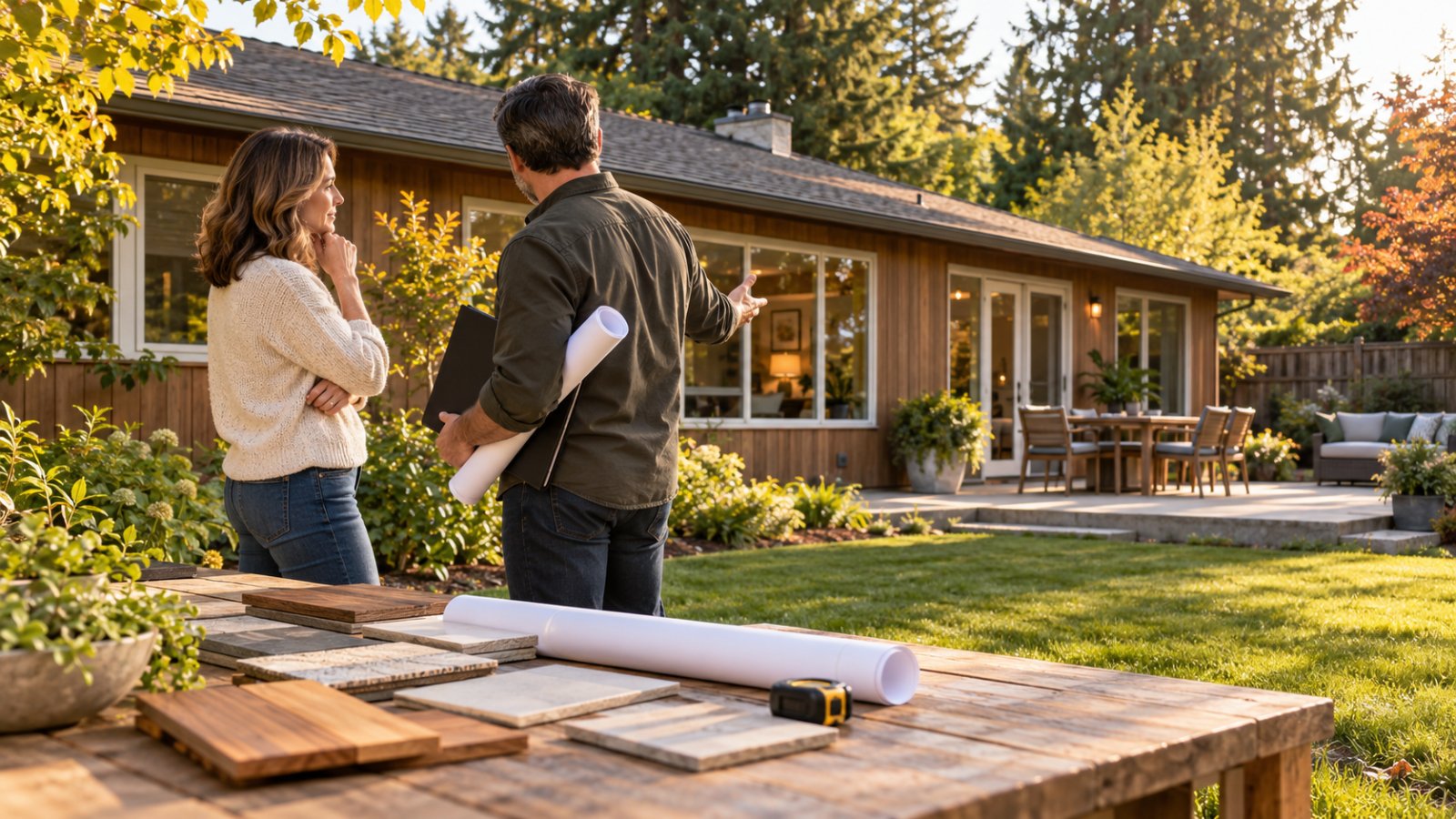
Should you remodel, add space, or move in Pierce County?
Remodel or add on if you love your location, your lot can support the space you need, and the finished home won’t be priced far above similar homes nearby. Move if the problem is something a remodel can’t fix — lot size, commute, school district boundary, a shop or RV parking you can’t add — or if the project would cost close to what moving costs. Compare the two in total dollars, months of disruption, and what your home would be worth afterward.
Your home has served you well. But now the kids share a room, someone works from the dining table, and there’s nowhere to park the boat.
Many Pierce County homeowners also have a low mortgage rate they’d rather not give up. So the question comes up in almost every move-up conversation I have: should we fix this house, or find a new one?
There’s no universal answer, but there is a clear way to decide. For the full move-up picture — equity, financing, and timing — start with our move-up homeowner guide.
Start with the problem, not the project
Write down exactly what isn’t working. Then sort each item:
Problems a remodel can usually solve:
- Dated kitchen or bathrooms
- A closed-off layout
- Not enough bathrooms
- A need for a home office or flex room
- An unfinished basement or bonus room
Problems a remodel usually can’t solve:
- Lot too small for the addition, shop, or yard you want
- Commute or location that no longer fits
- School district boundary or proximity to work, family, or activities
- No room for RV parking or outbuildings due to setbacks or HOA rules
- Wanting single-level living when the home is a two-story on a slope
If most of your list falls in the second group, moving is probably the answer, no matter how good the remodel looks on paper.
Compare the real costs
The cost of remodeling or adding on
Remodel costs in the Puget Sound region run higher than national averages. Get at least two written bids from licensed contractors, and add:
- Permits and design — your city or Pierce County Planning and Public Works sets requirements, and additions often need plans and inspections
- A contingency of 10% to 20% for surprises, especially in older homes
- Temporary living costs if the kitchen or main bath is out for weeks
- Financing costs if you use a HELOC, cash-out refinance, or renovation loan
What remodels return at resale
Nationally, Zonda’s 2025 Cost vs. Value report found exterior replacement projects returned the most at resale. A midrange minor kitchen remodel — about $28,458 — recouped an estimated 112.9%. Larger projects such as additions and major remodels typically recover a smaller share of their cost.
Resale value isn’t the only reason to remodel. But if you might sell within a few years, it matters.
The cost of moving
Moving costs include selling costs on your current home, buying costs on the next one, moving expenses, and — for many families right now — a higher interest rate. Our worked example of what moving up really costs lays out every line.
A side-by-side example
Here’s an illustrative comparison for a family in a $650,000 Pierce County home with a 3.25% mortgage who wants a fourth bedroom and a second living space. These are assumptions, not quotes.
| Add on (about 500 sq. ft.) | Move to a $850,000 home | |
|---|---|---|
| Upfront cost | $175,000–$250,000 construction, permits, design | Selling and buying costs, plus moving — often $50,000–$70,000 |
| Monthly payment impact | HELOC or second loan payment added; keep 3.25% first mortgage | New loan at today’s rates — often a much larger payment |
| Disruption | 4–9 months of construction | 1–3 months of selling, buying, and moving |
| Solves lot/location issues? | No | Yes |
| Value afterward | Must stay realistic for the street | Set by the new home’s market |
Neither column is “right.” For some families, keeping the low rate and adding space is the better financial move. For others, the addition costs nearly as much as moving — and still leaves them on a lot that doesn’t fit. Our guide on whether to keep your low mortgage rate or move up goes deeper on the rate question.
Watch out for over-improving
A home is valued against the homes around it. If every home on your street sells between $600,000 and $700,000, a $250,000 addition may not push yours to $900,000.
Before you commit, ask for a quick comparative market analysis that estimates your home’s value after the project. If the finished home would be the most expensive on the street by a wide margin, take that seriously — especially if you might sell within five years.
Don’t forget the in-between options
- Finish existing space — a basement, bonus room, or garage conversion is often cheaper than a true addition
- Reconfigure — removing a wall or converting a formal dining room can solve a layout problem for far less
- Add an ADU — Washington has expanded options for accessory dwelling units, which can house family or create income. Here’s what to know about ADUs in Pierce County
- Small, high-return updates — paint, flooring, and lighting can make a home feel new while you decide. Here’s which improvements tend to pay off
Questions I’d ask before deciding
- How long do we plan to stay — five years, ten, or longer?
- Can our lot and zoning support what we want to add?
- What would the home be worth after the project?
- How would we pay for it, and what does that do to our monthly budget?
- Can our family live through months of construction?
- If we moved instead, what would our next home cost, and what would our payment be?
Frequently Asked Questions
Is it cheaper to remodel or move?
It depends on the project. Small and midsize remodels are usually cheaper than moving, especially if you have a low mortgage rate. Large additions can approach or exceed the cost of moving, so compare total costs, financing, and your home’s value afterward.
Do I need a permit to add on to my house in Pierce County?
Additions and most structural changes require permits from your city or, in unincorporated areas, Pierce County Planning and Public Works. Check setback, lot coverage, septic, and HOA rules before you design.
What home improvements add the most value?
Nationally, Zonda’s 2025 Cost vs. Value report found exterior projects such as garage door and entry door replacements returned the most, and a midrange minor kitchen remodel recouped about 112.9% of its cost. Large additions typically recover less of their cost at resale.
How do I know if I’m over-improving my home?
Compare your home’s estimated value after the project with recent sales of similar homes nearby. If your finished home would be priced well above the street, you may not recover the cost when you sell.
Can I keep my low mortgage rate and still get more space?
Yes. Many homeowners finance a remodel or addition with a HELOC or home equity loan while keeping their first mortgage. Compare the total payment with what you’d pay on a new home at today’s rates.
Make the decision with real numbers
Remodeling and moving can both be smart. The right answer comes from your list of problems, your lot, your rate, and what your home would be worth when you’re done.
If you’d like a side-by-side look at your home’s value, a remodel scenario, and what moving up would cost, schedule a move-up strategy conversation with The Barnard Group. We’ll give you clear numbers so you can choose with confidence.
About Josh Barnard
Josh Barnard is the founder of The Barnard Group and has spent over 20 years helping families navigate some of life’s biggest moments through real estate. Known for his “Work Hard. Be Kind.” approach, Josh combines expert market knowledge, innovative marketing, and genuine care to help homeowners make confident decisions about their next chapter. Whether someone is buying their first home, moving up, downsizing, or relocating to Pierce County, his mission is simple: serve people well, create unforgettable experiences, and help families build a life they love.
Researched October 4, 2026. Cost examples are illustrative, not bids or loan offers. Remodel returns are national averages; local results vary.