

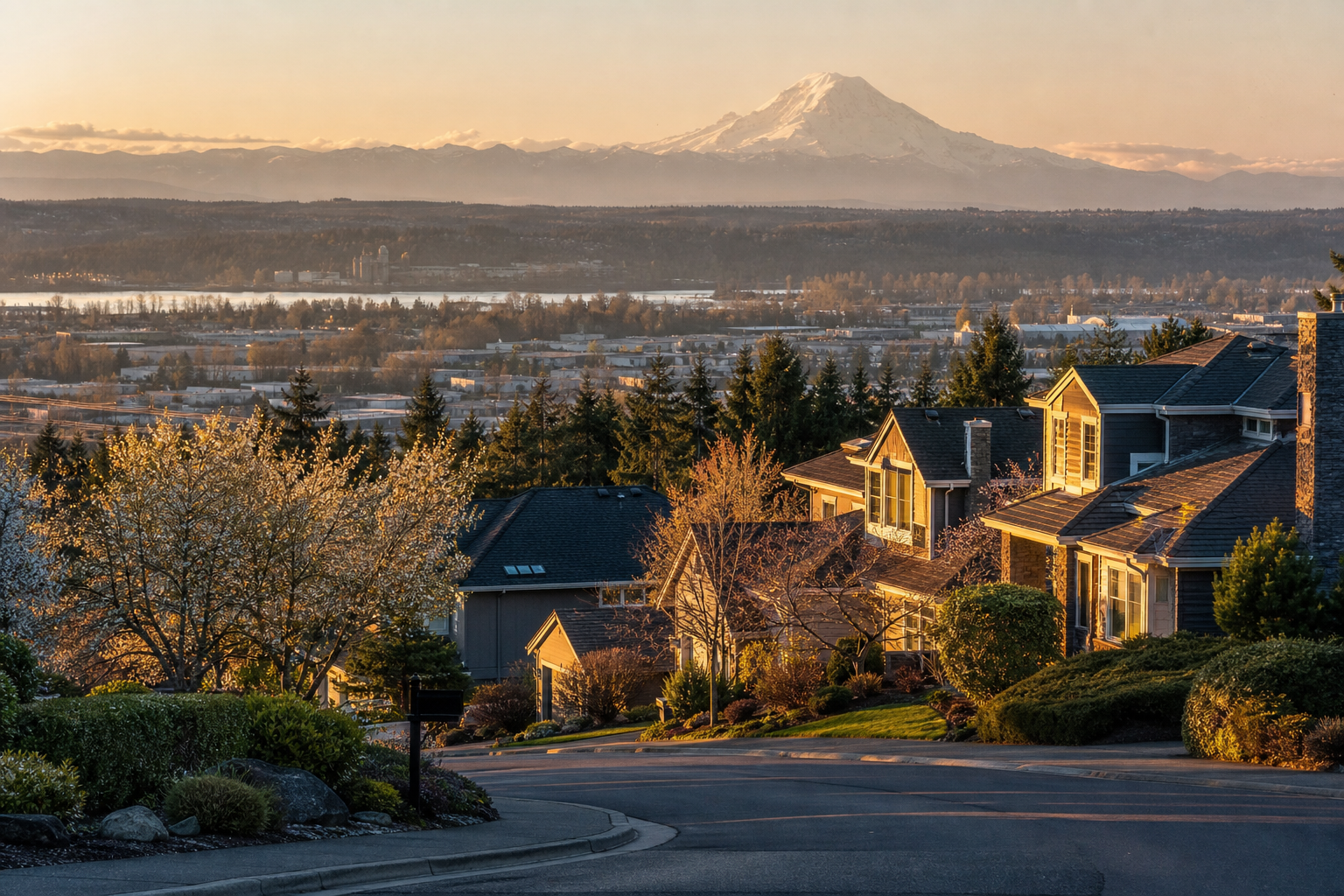
In a tight Pierce County market, accurate initial pricing attracts serious buyers quickly, reduces time on market, and limits the negotiating leverage an overpriced listing hands to buyers. With inventory rising and buyers growing more selective, the first price you set carries more weight than ever.
Why does pricing matter so much in a tight Pierce County market?
In a tight Pierce County market, the first price you set determines whether buyers schedule a showing or scroll past your listing entirely. With inventory rising and buyers growing more selective, an overpriced home no longer gets the benefit of the doubt, it gets skipped. Accurate pricing from day one is how sellers stay competitive, protect their timeline, and avoid the damage a price reduction does to buyer perception.
Key Takeaways
- Pierce County inventory rose 17.2% year over year in July 2026, giving buyers more alternatives and making overpriced listings easier to ignore.
- Recent local market data shows a median sale price of $545,000 in Puyallup with a median of 33 days on market, but results vary sharply by submarket, from 20 days in Tacoma to 56 days in Orting.
- Pierce County had 3.33 months of housing inventory in July 2026, a more balanced environment than the tightest recent periods, favorable for sellers, but not a blank check to price above the market.
- Gig Harbor trades at a fundamentally different price point than the rest of the county, the area’s median reached approximately $939,000 in September 2026, which is why submarket comparables matter more than a single countywide benchmark.
- A price reduction after a listing goes stale signals to buyers that something is wrong, often producing lower offers than a correct price on day one would have.
What does the Pierce County market actually look like right now?
The tight Pierce County market of 2026 is not the frenzied, anything-goes environment some sellers remember from a few years back. It is tighter than a balanced market, but it is not a seller’s automatic advantage.
According to the Northwest Multiple Listing Service, Pierce County carried 3.33 months of housing inventory in July 2026. That is meaningfully below the six months that traditionally signals a balanced market, but it is also higher than the near-zero supply levels that drove bidding wars a few years ago. Meanwhile, South Sound Magazine’s reporting on the NWMLS July 2026 data confirmed that Pierce County active listings rose 17.2% year over year. Statewide, NWMLS data shows active listings across Washington increased 22.0% year over year in August 2026.
What that means practically: buyers have options. They are comparing your home to others. And if your price does not align with what the market supports, they will move on, often without telling you why.
How much do prices vary across Pierce County?
Submarket variation is one of the most important and most underestimated factors in Pierce County pricing. A single countywide number tells you almost nothing useful about what your specific home should be priced at.
The table below shows recent area-level medians across the markets I work in. These are aggregated from public listing data, trailing approximately 90 days as of October 2026. An individual home’s value depends on condition, street, build year, and timing, but this gives you a sense of how dramatically the landscape shifts from one community to the next.
| Area | Median Sale Price | Median Days on Market |
|---|---|---|
| Puyallup | $545,000 | 33 |
| Tacoma | $480,000 | 20 |
| Bonney Lake | $700,000 | 35 |
| Edgewood | $782,950 | 45 |
| Orting | $526,000 | 56 |
| Spanaway | $504,500 | 53 |
| Sumner | $555,000 | 42 |
| Milton | $643,000 | 55 |
Notice the spread: Tacoma homes are moving in a median of 20 days, while Orting sits at 56. Bonney Lake’s median is $155,000 higher than Spanaway’s. Pricing a Spanaway home like a Bonney Lake home, or vice versa, is not a rounding error. It is a strategy that will cost you time and money.
And Gig Harbor sits in its own category entirely. The News Tribune reported that the Gig Harbor area, spanning from the Tacoma Narrows Bridge to the Purdy Bridge and including Fox Island, saw a median sale price of approximately $939,000 in September 2026. That is not a countywide number. It reflects a distinct premium submarket with its own buyer pool and its own pricing logic.
This is exactly why I build pricing recommendations from the property’s actual competitive set: neighborhood, lot, condition, renovations, commute patterns, proximity to employers like Joint Base Lewis-McChord. A tight Pierce County market rewards precision, not approximation.
What happens when you get the price wrong?
Overpricing is the most common and most costly mistake I see sellers make. Here is what the pattern looks like in practice.
A home hits the market at a price that feels aspirational. The first week generates some online views but few showings. By week two, the listing is already losing its “new to market” visibility in search results. By week three, buyers and their agents are asking the same question: why is it still available?
That question, why is it still available?, is the one you never want buyers asking. Once it enters the conversation, it hands negotiating leverage to the buyer. They start wondering what is wrong with the property, even when nothing is. And when the price reduction finally comes, it does not reset the clock. It confirms their suspicion that the seller was off-base from the start.
Pricing right the first week beats chasing the market down. I have watched sellers net less from a reduced-price sale after 60 days than they would have from a clean offer in week one at the right number. The math is not complicated, the carrying costs, the concessions, and the psychological shift in buyer behavior all work against you once a listing goes stale.
For a deeper look at what to examine when a home is not moving, the post Why Isn’t My House Selling in Pierce County? walks through the diagnostic questions worth asking before any price adjustment.
Should you price below market to spark a bidding war?
This is a strategy that worked reliably in 2021 and 2022. In the current tight Pierce County market, it is a higher-risk move than it used to be.
With inventory up 17.2% year over year and buyers carrying more options, a below-market list price does not automatically trigger a competitive offer environment. It can, but only if the home is compelling enough in condition and presentation to draw multiple serious buyers simultaneously. If it does not, you have simply priced yourself low and left money on the table.
The better path is accurate pricing paired with strong preparation. Condition and presentation carry more weight now that buyers have become more selective, a well-staged, well-priced home in a market with real competition is a different animal than the same home priced to generate buzz but showing poorly.
If you are thinking about what to do before you list, Which Improvements Are Worth Making Before You Sell in Pierce County? covers how to focus your prep dollars where they actually move the needle.
How often should you adjust price if showings are slow?
There is no universal answer, but the signal to watch is showing activity in the first two weeks, not offers. If qualified buyers are touring the home and not writing offers, that is a condition or presentation signal. If buyers are not touring at all, that is almost always a price signal.
I generally look at the first 10-14 days as the diagnostic window. If showing volume is materially below what comparable active listings are generating, a price conversation needs to happen before the listing loses its momentum entirely. Waiting four or five weeks to act turns a manageable correction into a visible one.
The post Pierce County Listing Agent: Pricing and Reductions goes deeper on how to read those early signals and what a strategic reduction looks like versus a reactive one.
How do you know if your home is priced correctly?
The honest answer is that you need a comparative market analysis built from your property’s actual competitive set, not a national estimate, not a countywide average, and not what your neighbor sold for two years ago.
A well-constructed CMA for a Pierce County home accounts for recent closed sales (typically within the last 90 days), active competition, pending sales, and expired listings. Expired listings matter because they tell you where the market said “no.” They are the ceiling, not the floor.
According to the Washington Center for Real Estate Research at the University of Washington, Washington single-family home sales in Q2 2026 increased 46% from Q1 2026 but were only 1% higher than Q2 2025. That quarter-to-quarter jump reflects seasonal demand patterns, not a permanent acceleration, which means a CMA built on data that is six months old may be working from a different market than the one your buyer is shopping in today.
Your specific number depends on your home’s condition, location, and timing. That is exactly the kind of analysis I walk my clients through before we ever set a list price, and it is why the right starting point is a conversation, not an algorithm.
If you want to understand the mechanics in more detail, How to Price Your Home to Sell in Pierce County covers the full process from comparable selection to final list price strategy.
If you have found this useful, I invite you to read what past clients have said about working with The Barnard Group on Google.
FAQ: Pricing a Home in Pierce County
How do I know if my Pierce County home is priced correctly?
The clearest signal is showing activity in the first two weeks. If your home is generating tours but not offers, the issue is likely condition or presentation. If it is not generating tours at all, price is almost certainly the problem. A comparative market analysis built from recent closed sales, active competition, and expired listings in your specific submarket is the most reliable starting point, and it needs to reflect your neighborhood, not just a countywide average.
Is Pierce County still a seller’s market in October 2026?
Pierce County had 3.33 months of housing inventory in July 2026, according to the NWMLS, which is below the six-month threshold that defines a balanced market. That said, inventory rose 17.2% year over year, giving buyers more choices than they had a year ago. The conditions favor sellers who price and present well, they do not automatically favor every seller regardless of how a home is positioned.
How long are homes taking to sell in Tacoma, Puyallup, or Gig Harbor?
Recent local market data shows meaningful variation: Tacoma homes are moving at a median of 20 days, Puyallup at 33 days, while areas like Orting and Milton are running 55-56 days. Gig Harbor operates as a distinct premium submarket, The News Tribune reported a median sale price of approximately $939,000 for the Gig Harbor area in September 2026. Days on market in any submarket reflect both pricing accuracy and seasonal demand, so these figures shift, your home’s specific timeline depends on where you are and how you enter the market.
What happens if I overprice my Pierce County home?
An overpriced listing loses its “new to market” visibility quickly, generates fewer showings, and eventually prompts buyers to wonder what is wrong with the property, even when nothing is. When the price reduction comes, it often produces lower offers than a correct price on day one would have, because buyers perceive negotiating leverage in a home that has been sitting. The longer a home stays on market without selling, the harder it becomes to recover full value.
Does pricing strategy differ between Tacoma, Puyallup, Bonney Lake, and Gig Harbor?
Yes, significantly. Recent data shows median sale prices ranging from $480,000 in Tacoma to $700,000 in Bonney Lake to approximately $939,000 in the Gig Harbor area, these are not variations of the same market, they are distinct submarkets with different buyer pools, different absorption rates, and different competitive dynamics. A pricing strategy built from the right comparable sales for your specific community will outperform one based on a countywide average every time.
Getting the price right from the start is the single most controllable variable in how your sale goes. If you are thinking about listing in the tight Pierce County market, I am happy to walk you through a market analysis and talk through what your home is positioned to do. Book your complimentary Home Selling Strategy Session and let’s build a plan that works.
Equal Housing Opportunity. Josh Barnard is a licensed REALTOR® regulated by the Washington State Department of Licensing. This article is general information only and does not constitute legal, tax, or financial advice. Confirm your specific costs and transaction details with your closing agent, tax advisor, or lender.