
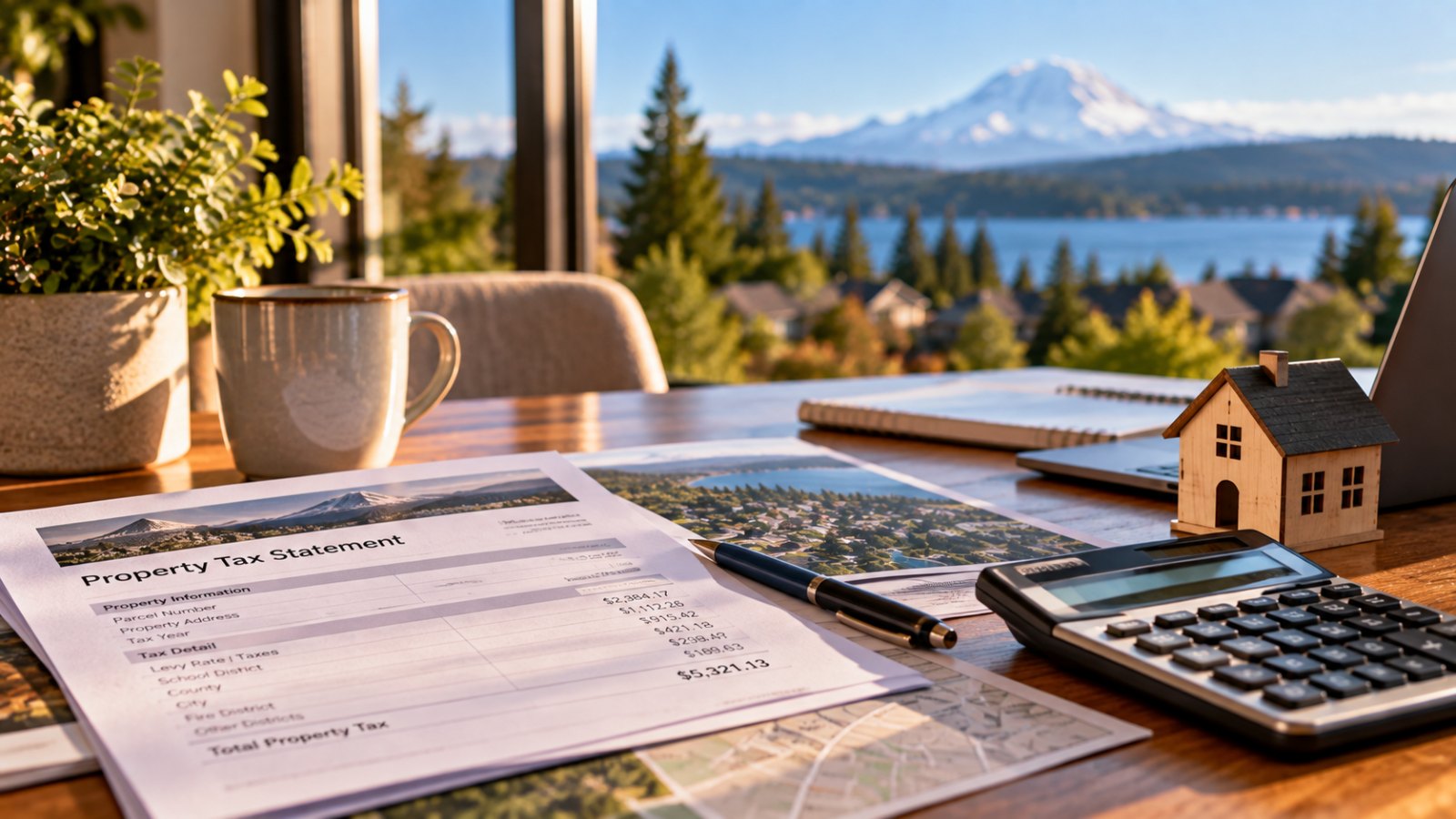
Pierce County property taxes are calculated by multiplying your home’s assessed value by the combined levy rate for your tax code area, the specific mix of school district, fire district, city or county, library, and other taxing districts where the home sits. The Pierce County Assessor-Treasurer revalues property every year, tax statements go out in February, and if your bill is over $50 you can pay half by April 30 and the second half by October 31.
For buyers comparing homes, and especially for families relocating from another state, the key takeaway is this: two similar homes a few miles apart can have noticeably different tax bills. Look at the actual tax history for every home you’re serious about.
How the bill is calculated
The basic formula:
Assessed value ÷ 1,000 × levy rate (per $1,000) = annual property tax, before any exemptions or special assessments.
For example, a home assessed at $600,000 in an area with a combined levy rate of $10.00 per $1,000 would owe about $6,000 a year. That rate is only an illustration. Actual rates vary by location, so look up the real rate for the parcel you’re considering.
How your assessed value is set
- Market value standard: Washington law requires assessors to value property at 100% of true and fair market value, as the Department of Revenue explains.
- Annual revaluation: Pierce County updates assessed values every year.
- One year behind: Values reflect market value as of January 1 and are the basis for taxes payable the following year. For example, values as of January 1, 2025, set taxes payable in 2026.
- Value notices: Owners receive a notice when values change, typically in early summer.
Unlike some states, Washington does not reset your assessment to your purchase price when you buy. The assessor’s annual market valuation continues regardless of what you paid, though sales in your area feed into those valuations.
Why the levy rate differs across the county
Your combined rate is a stack of levies from every taxing district that covers your property. That typically includes the state school levy, your local school district, the county, a city (if you’re inside one), fire and EMS, library, parks, and sometimes port or other districts.
Some levies are subject to limits on how much total revenue can grow each year, while voter-approved levies, such as school levies, bonds, and some fire and EMS levies, can add to the rate. That’s why a home in one school district or fire district can carry a different rate than a similar home nearby. Washington’s regular levy limits are explained on the Department of Revenue’s property tax page.
Comparing homes in different Pierce County communities?
Josh can pull the tax history for the homes on your list so you’re comparing the true monthly cost, not just the price. Start your search with The Barnard Group.
Key dates and how you pay
| What | When |
|---|---|
| Valuation date | January 1 (for taxes payable the following year) |
| Value change notices | Typically early summer |
| Appeal deadline | July 1 or 60 days after the value notice is mailed |
| Tax statements mailed | February |
| First-half payment due | April 30 |
| Second-half payment due | October 31 |
Most buyers with a mortgage pay property taxes through an escrow (impound) account, where the lender collects a portion with each monthly payment and pays the county. Pierce County’s Assessor-Treasurer handles valuation and collection.
What happens to taxes at closing
Property taxes are prorated at closing. If the seller has already paid the first half, the buyer typically credits the seller for the days the buyer will own the home. If taxes are due but unpaid, escrow usually pays them from the seller’s proceeds. Your lender may also collect a few months of taxes upfront to fund the escrow account. See our guide to buyer closing costs in Pierce County.
A note on new construction
On a newly built home, the current tax bill may reflect only the value of the land, or a partially completed home, because of the one-year lag in valuation. Once the finished home is assessed, the bill can rise significantly. Ask your lender to estimate taxes on the finished value so your payment doesn’t jump later. Our guide to buying new construction in Pierce County covers other details to check.
Appealing your assessed value
If you believe your assessed value is higher than market value, you can appeal to the Pierce County Board of Equalization. The county lists the filing deadline as July 1 or 60 days after the value change notice is mailed. Strong appeals rely on recent comparable sales and documentation of the home’s condition. Keep in mind that you’re appealing the value, not the tax rate.
Exemptions for seniors and people with disabilities
Washington offers a property tax exemption program for qualifying senior citizens and people with disabilities. In Pierce County, the eligibility requirements include age or disability, owning and living in the home as your principal residence, and a household income limit, which the county currently lists as $64,000. Details and applications are available from the Assessor-Treasurer.
Frequently asked questions
Will my taxes go up when I buy?
Not because of the sale itself. Washington doesn’t reset assessments to purchase price. But taxes can rise year to year as values and voter-approved levies change.
How do I find the taxes on a specific home?
Use the Pierce County Assessor-Treasurer’s parcel search to see the assessed value, tax history, and tax code area. Your agent can pull this for any listing.
Are property taxes higher in cities than in unincorporated areas?
Not automatically. City, fire, library, and school levies all interact, so compare actual parcels rather than assuming.
Know the full cost before you buy
Price is only part of the monthly payment. Book a complimentary strategy session with Josh Barnard and The Barnard Group to compare homes, communities, and the real cost of owning each one.
This article is general information, not tax advice. Tax rates, exemption thresholds, and deadlines change; confirm current details with the Pierce County Assessor-Treasurer.